
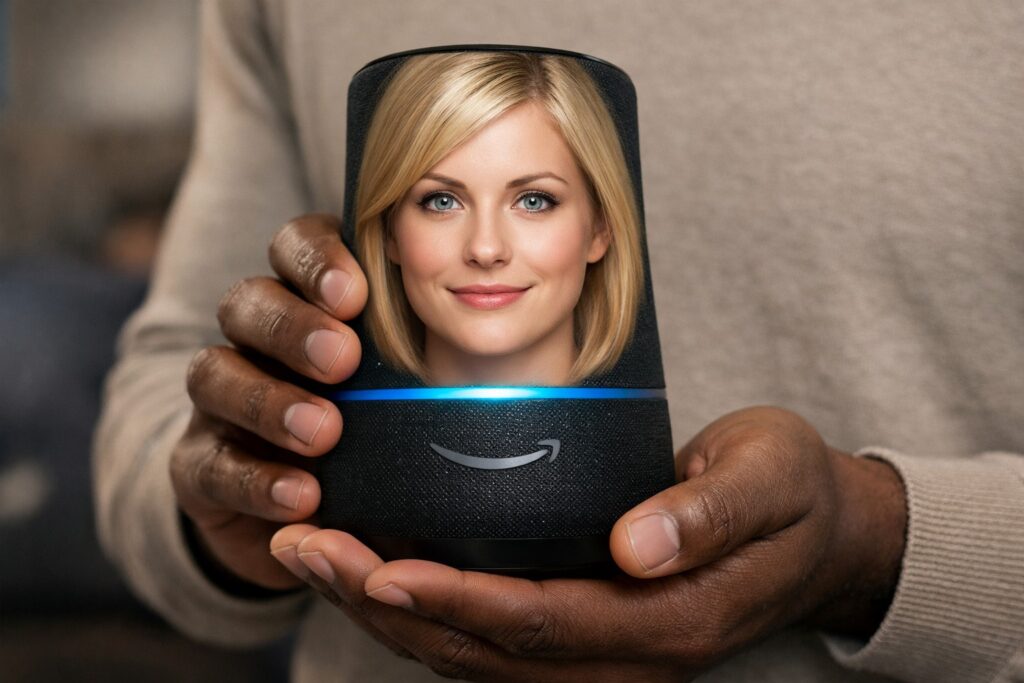
Why Siri, Alexa, and AI Don’t Sound Black?
- by Dr. Usher
- Opinion
- Copyright April 17, 2026
- 2.8M+
Has anyone reading this noticed something a little off about how your AI sounds?
Not wrong. Not broken. Just… different.
When you talk to your device and it responds, have you ever paused and thought, “Why does it sound like that?” Not just the words it uses, but the tone. The rhythm. The way it seems to “speak.”
If you’re culturally aware, you might have picked up on it already. There is a specific pattern and influence there—something that feels familiar, but you can’t quite place. Most people never notice it, but once you do, you cannot unhear it: AI has a “White” default.
From Apple’s Siri to Amazon’s Alexa, these assistants are hardwired to be Eurocentric. It’s not a technical glitch; it’s a design choice. Think about it: if you ask your device to use a British, Australian, or even an Indian accent, it does so with ease. But the moment you look for a Black voice or the natural rhythm of AAVE (African American Vernacular English), the system hits a wall.
By treating standard white speech as the “neutral” or “objective” baseline, tech developers have effectively coded a racial hierarchy into our pockets. They’ve decided that one specific identity is the “universal” voice of help and authority, while excluding Black identity entirely. But, you should know, this practice is nothing new. This exclusion isn’t just a tech issue; it’s a modern reflection of a much older pattern. This digital “neutrality” is actually part of a centuries-old blueprint where the white experience is framed as the universal human standard rather than just one specific perspective.
The dominance of the white narrative functions as a “systemic default,” where the white experience is historically framed as the universal human standard rather than a specific cultural perspective. This was achieved through centuries of institutional control over the “global record”—printing presses, map-making, and academia—allowing European perspectives to define history and progress while relegating other cultures to the margins. Because white individuals have historically occupied the roles of gatekeepers in media and industry, they have held a monopoly on deciding which stories are told and whose achievements are celebrated. This creates a feedback loop where whiteness becomes the invisible baseline for beauty, professionalism, and intelligence, forcing all other identities to be measured against a standard they did not help create.
So now that you are aware of this, the question is simple.
What are you going to do about it?
Awareness without action changes nothing. If this is truly an issue of representation, design, and influence, then it deserves to be challenged in real ways, not just noticed and ignored.
Start here:
Call attention to it publicly
Use your voice on social media. Speak about it clearly and directly. Tag companies like Amazon and Apple. Comment on their posts. Ask the question where others can see it. When enough people raise the same concern, it stops being invisible.Send direct emails
Reach out to these companies through their support and corporate channels. Keep it simple and direct. Ask why diverse voices, including Black voices and linguistic styles, are not fully represented. Companies track feedback more closely than people realize.Ask for specific change
Do not just complain. Be clear about what you want. Ask for the inclusion of culturally diverse voice options, including those that reflect African American speech patterns. Specific requests are harder to dismiss.Support what reflects diversity
When products, platforms, or developers begin to offer more inclusive options, use them. Promote them. Adoption tells companies that this matters.Keep the conversation going
This is not a one time post. It is an ongoing conversation. The more consistently it is raised, the more pressure builds for change.
The reality is this: technology does not shape itself. People shape it. And if people stay silent, the defaults will never change.
Note: All comments on this thread have been disabled to protect your privacy. If you have comments or prayer requests, please email: [email protected]
Nota: Todos los comentarios en esta publicación han sido deshabilitados para proteger tu privacidad. Si tienes comentarios o peticiones de oración, por favor escribe a: [email protected]